
Trace Wells County's Former Owners
A backward chain is a transfer timeline. It is more than a list of names. Start with a confirmed current deed, record its grantor and grantee, then find the deed by which the grantor acquired the parcel, and repeat. Wells County sources overlap, but their date ranges and purposes differ, so match each step to the right record.
| Transfer date | Grantor to grantee | Deed type | Book, page, or instrument |
|---|---|---|---|
| Newest recorded date | Prior owner to current grantee | As indexed | Copy exactly from Doxpop or Recorder |
| Prior transfer | Earlier grantor to that prior owner | As indexed | Repeat the cited reference |
| Earlier deed-book entry | Named seller to buyer | Read from instrument | Book and page from microfilm |
| Transfer-book bridge | Owner sequence by township | Transfer entry | ArcaSearch finding reference |
Never fill a missing cell from memory. Dates, names, deed types, and citations must come from the actual index or image, not guesses. Investigate any skipped probate or affidavit transfer. Do not force a sale that never happened.
Wells County Ownership Time Depth
The Recorder states that its records are on microfilm beginning June 1, 1965. That is a microfilm start date. It is not a promise about online coverage. Doxpop serves as the online deed-index entry point, though its exact Wells County cutoff and image access are not stated. Treat the two separately. The Auditor provides a second historic route. Its ArcaSearch Transfer Book and Plat Book Digital Archive covers every Wells County township from 1836 through 2020 and works as a digitized transfer archive apart from the Recorder index.
Two timelines. Recorder microfilm starts June 1, 1965; Auditor transfer books span 1836-2020. Verify Doxpop's own cutoff before stating it.
Reconstruct Wells County Ownership Backward
Search each owner twice in the grantor-grantee structure. First find that person as grantee on the deed that conveyed the land. Note the grantor there, who is the previous owner. Widen the name search to catch spelling variants before narrowing by date or document type.
- Find the present owner's acquiring deed and confirm the legal description.
- Read the grantor on that deed as the next previous-owner candidate.
- Search that grantor as a grantee to find the earlier acquisition, then compare the same tract.
- Repeat until online access ends, then continue through microfilm, deed books, and the Auditor archive.
- Grantor
- The party conveying the stated interest.
- Grantee
- The party receiving that interest.
- Chain of title
- The ordered link of instruments affecting ownership.
- Reverse index
- An index arranged to help find parties in the opposite deed role.
- Warranty and quitclaim
- Different deed forms whose legal effect must be read from the instrument.
Wells County Transfer Book Bridge
The ArcaSearch archive is the strongest local bridge when prior owners reach past a modern portal or the parcel numbering changed. Its coverage spans every township from 1836 through 2020. The archive's search behavior is not exposed. Use it as a finding aid. Confirm any transfer in the Recorder's deed or plat record before you rely on it. The Wells County transfer and plat archive shows the historical collection entry point.
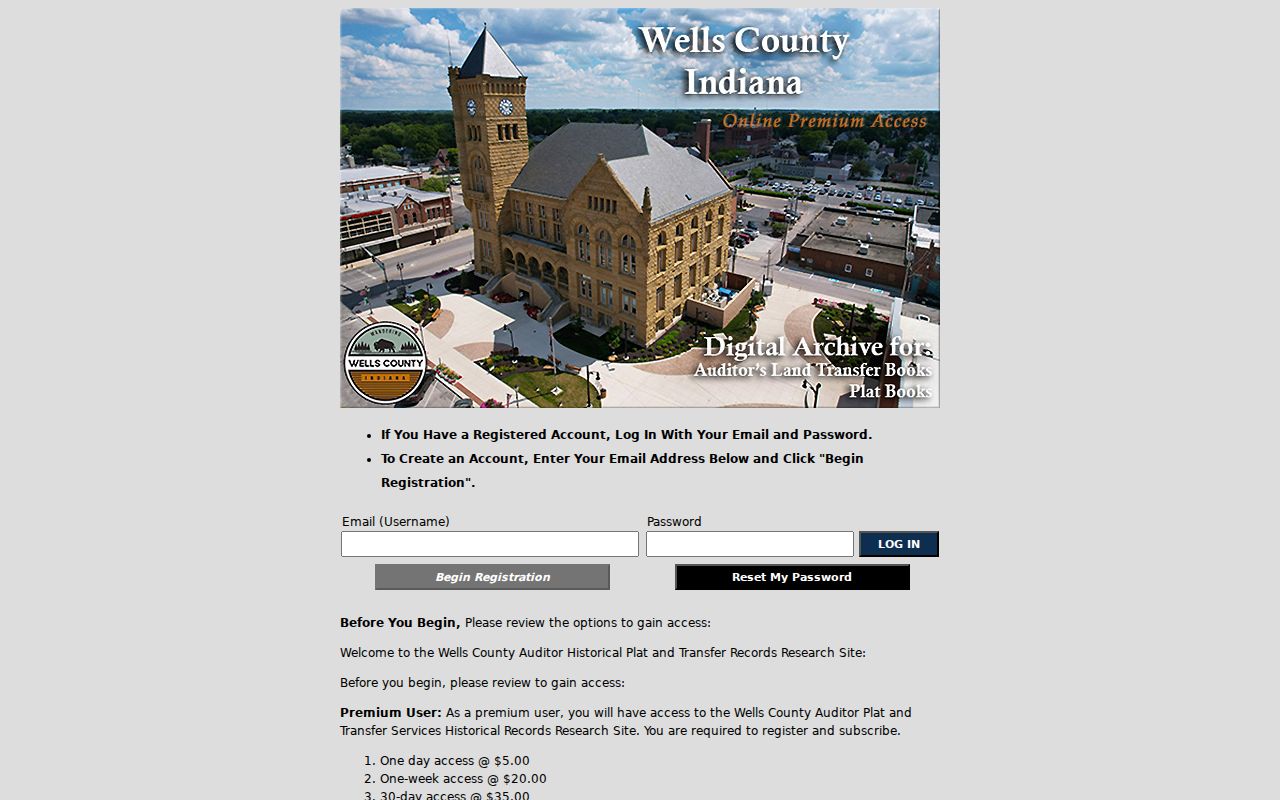
The archive's 1836-to-2020 span sets it apart. Neither the Recorder microfilm start date nor the Doxpop cutoff matches that reach.
Wells County Address Changes
Street addresses change while the land stays the same. Carry the subdivision, lot, block, section, township, range, and deed references forward instead. Bluffton's 1968 and 1977 directory maps can bridge an old address. Ossian's 1917 plat and Sanborn maps orient early lots, while Markle records may use the old town name Tracy or named additions.
Try Markle additions when a street search fails. Madduxville, Cline or Wildcat Reserve, Nedrow, and Allen all appear there. A mailing city can sit outside the corporate line. Markle spans two counties. Confirm Wells or Huntington before choosing a recorder.
Note: A directory or Sanborn map supports a hypothesis about identity; it does not establish title or an exact present boundary.
Estate Breaks in Wells County
A clean chain can break at death. Watch for personal-representative deeds, affidavits, survivorship language, probate orders, and any other instrument affecting title. The Wells Circuit and Superior Court Clerk offices hold estate and will files, and public case coverage may appear in Indiana MyCase.
The online case display is not the official court record, so ask the Wells Clerk for the complete or certified file when an order explains a transfer. A death certificate may support identity. Direct-interest rules apply. It is not a deed.
Library Clues to Wells Owners
The Wells County Public Library Indiana Room holds deed and plat indexes, maps, Sanborn sheets, newspapers, directories, and Cem-Obit material, which blends cemetery, obituary, marriage, and plot references. Volunteer errors can occur. The library itself posts that warning.
Remote research runs through a request form. Rates are $2.50 per 15 minutes or $10 per hour, with an initial cap of two hours or $20 and a stated one-to-four-week estimate. Give the owner name, parcel place, approximate years, and known deed or plat terms. Then test the result against county land records.
Offline Wells County Deed Research
The Recorder sits at 102 W Market Street, Suite 203, in Bluffton, open weekdays from 8:00 a.m. to 4:30 p.m. Call 260-824-6507 first. Email recorder@wellscounty.org works too. Ask about index terminals, microfilm, deed books, and copying.
Indiana APRA, IC 5-14-3, permits an oral or written request when a record is not online. A focused request names the grantor or grantee, date span, document type, parcel, and known book or page. The office need not create an ownership history.
Limits of Wells County Ownership History
Dates tell different stories in Wells County. A statute created the county in 1835. The Auditor's transfer archive opens in 1836. Clerk records begin in 1837. Planning material leans on that later year for the establishment date. Treating any one record series as the county's true starting point misreads what these milestones mean. Property records research should keep them separate rather than collapsing them into a single origin claim.
An ownership chain also has natural stopping points. Wells County sources can carry a parcel back only until the evidence thins out. While state or federal land-entry records sometimes extend the trail to an original patent, no local search should promise that outcome. For older deeds and missing indexes, the Indiana State Library, the Indiana Archives, FamilySearch access through the library, and the Historical Society remain the useful fallbacks.
Use records with care. Research previous Wells County owners for land and family history, and never use the results to stalk or harass anyone.