
Three Wells County Property Value Measures
Indiana assesses real property at 100 percent of true tax value. The state defines that standard as market value-in-use. The Assessor reaches the figure through mass appraisal applied countywide. It is not the same animal as a negotiated price between buyer and seller. Nor does it match an appraisal prepared for a single parcel by a licensed professional. Check the label and the effective year before you set two numbers side by side.
| Value | What It Is | Where |
|---|---|---|
| Assessed value | Mass-appraisal amount used in the property-tax system | Assessor card and Form 11 |
| Market value-in-use | Indiana's standard for value in the property's current use | Assessment records |
| Last sale consideration | The amount connected to one transfer, when disclosed | Sales disclosure, transfer record, or deed |
A recorded sale can be atypical, stale, or between relatives, and its terms may include things a mass appraisal never measures. Annual trending draws on sales evidence from the whole neighborhood, so the assessed value moves even when the subject parcel stays off the market. Treat an assessment as a dated public estimate rather than a replay of the latest purchase.
How Wells County Adjusts Assessed Value
The Wells County Assessor runs two separate valuation processes. Annual adjustment, also called trending, compares recent sales within a neighborhood. It keeps assessments close to Indiana's market value-in-use standard. Physical inspection follows a four-year cycle and updates characteristics that affect land or improvement value. The two schedules rarely line up. A neighborhood factor can change a property value with no new deed recorded. A remodel or demolition, by contrast, may not reach the parcel card at first. It can wait until a later inspection. So pair every dollar figure with its assessment date before you rely on it. Note: Indiana's 100 percent ratio describes the assessment standard, not a promise that assessed value will equal a future sale price.
Read Wells County Value Fields Separately
A parcel result often splits land from improvements. It may also list deductions, taxing districts, and transfer history. Each field answers a different question, and a deduction can change taxable treatment without disturbing the mass-appraisal conclusion underneath it.
| Record field | How to interpret it |
|---|---|
| Land value | Assessor amount assigned to the site component |
| Improvement value | Amount assigned to buildings and taxable improvements |
| Total assessed value | Combined assessment before later tax calculations |
| Deduction or exemption | A qualification affecting taxable treatment |
| Transfer history | A dated conveyance clue that must be read in context |
Look Up a Wells County Property Value
The official starting point is the Assessor's office site, which routes to the Beacon property search. That portal supports lookup by owner, address, parcel ID, and tax ID. Use the narrowest identifier you have, and note the record date on whatever you find.
- Search the address, owner, or Wells parcel key and verify the situs.
- Record the year, land amount, improvement amount, and total assessed value.
- Read deductions separately from the base assessment.
- Check transfer history or the latest deed when a sale figure matters.
- Date the result and call the Assessor if a recent deed appears out of sequence.
- Assessed value
- The mass-appraisal amount used in Indiana's property-tax system.
- Market value-in-use
- The Indiana standard based on the property's current use.
- Assessment ratio
- The relation tested between assessments and sale evidence.
- Sale consideration
- A transaction amount tied to a particular transfer.
Why a Recent Wells County Deed May Differ
The county FAQ says deed cards update on March 1 and list the current owner. It publishes no fixed lag between closing and card. So do not assume 30, 60, or 90 days. For a recent sale, pull the newest instrument from the Recorder index and ask the Assessor how it fits the current assessment cycle. The two records differ by design. The Recorder preserves the transaction and its legal instrument. The Assessor values land under statewide rules and neighborhood evidence. Even with both sources fully current, their numbers can legitimately disagree.
Markle Numbers Illustrate Dated Value Context
The Markle comprehensive plan reported a 2021 median owner-occupied home value of $97,100. Huntington County stood at $113,300 that year. The statewide figure was $158,500. The plan also listed TIF district assessed-value totals for 2021. Those are community-level numbers. Neither one estimates a present Markle parcel on the Wells side of the line. Markle spans two counties. Confirm the county through GIS and the legal description before anything else. Then use the right assessor. Set the parcel card beside the recorded sale. A mailing ZIP cannot pick the correct assessment roll.
Use the Form 11 Year for Wells County Value
An assessment notice, commonly called Form 11, ties the value and appeal context to a specific tax year. The Assessor page supplies the forms and current guidance. Deadlines follow the notice and the rules that apply to it, so read the actual form rather than an old calendar. What the numbers mean is only half the picture. The Wells County property tax page covers bills, deductions, payment channels, and appeals. Value questions go to the Assessor. Payment questions go to the Treasurer. Note: Keep the Form 11, the parcel card, and the sale record together, because each documents a different part of the valuation story. The official Wells County Assessor value and appeal page gathers the county's annual-adjustment explanation, appeal material, and forms in one spot. That page shows the current process. Still, the date printed on an individual notice controls that parcel's response window.
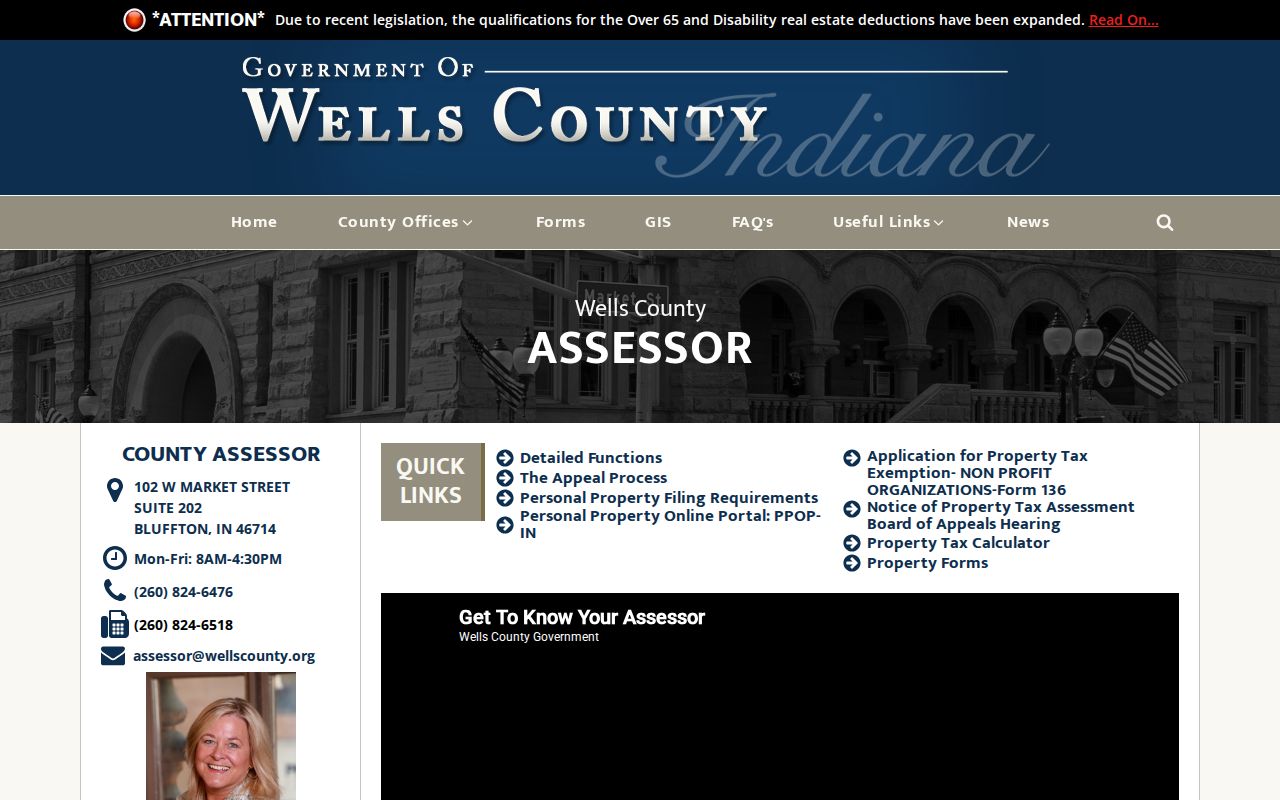
The Assessor's page shows the county's current annual-adjustment and appeal process. The date on an individual notice still controls that parcel's response window.
Request Wells County Value Records Offline
If Beacon is unavailable, visit the Assessor at 102 W Market Street, Suite 202, Bluffton. The office is open on weekdays from 8:00 a.m. to 4:30 p.m. Call 260-824-6476 or email assessor@wellscounty.org. Include the address, parcel key, owner if known, and assessment year. Indiana's Access to Public Records Act, IC 5-14-3, supports a request for an existing record. It does not require the office to produce a custom value study. Ask for a named item. Options include the parcel card, Form 11, or sales disclosure. Say whether you want an electronic or paper copy. Be precise about the year. One address can carry several valuation snapshots. Ask which figure you need. It could be the land value, the improvement value, the total assessed value, or the value after deductions. If the dispute concerns how a structure is described, name that characteristic. Include the dollar amount too. With those specifics, the office can locate an existing card or notice. That avoids asking the staff to create a market analysis.
Limits of a Wells County Assessed Value
A Wells County assessed value is a mass number. The assessor's method cannot inspect every detail. Condition, private sale terms, easements, and title problems may never reach the tax roll. Even a fast swing in local demand can escape it between appraisal cycles. Still, the record matters. It fixes the county's official figure, its method, and its year in one place.
Pair the value with companion sources for a fuller picture. A deed records the actual transfer. A GIS map locates the parcel, and a licensed appraisal builds a parcel-specific opinion. Comparing those angles explains why numbers differ, without letting any single one stand in for the rest.
Value is not price. A Wells County assessed value supports taxation and is not a promise of sale price or a licensed appraisal.